Thursday, August 1, 2019

Nepal (1981) Part 6

6 February 1981
Yesterday, Thursday, was a short hiking day and our last excursion below 8000 feet for the duration.  We began with a traverse/descent eastward, through the village of Phueli, through Rani Bon (Queen's Forest) and down to the Dudh Kosi at 5000 feet.  The name Dudh Kosi means "milky river" -- the water is a beautiful aquamarine color. Our trail now heads northward, following the course of the Dudh Kosi to its origin in Namche Bazaar.  The river valley is tremendously steep and deep.
A wedding celebrant.
We climbed several hundred feet up the eastern side of the river.  We paused near a little shack where a wedding procession had stopped.  The bride was brightly dressed and appeared to be about 14 years old.  The groom may have been 16-18.  The groom's family gave the bride's rakshi, I suppose to ease the loss, and everyone was smoking tobacco rolled up in green leaves.  All appeared to be having a grand time except the bride. 
Young women carrying firewood near Jubing.
Our lunch stop was in a Rai village, Jubing, at 5500 feet and only about 10 minutes beyond the wedding scene.  It was quite warm and there was a middle-sized stream where I washed more thoroughly than I have since we started trekking.
Rai children at Jubing.
From Jubing, we climbed about 1000 feet up an incredibly steep spur (it seems that stretches must have approached a 60 degree pitch.  We then traversed northwards around a side valley, crossing a short ridge, and descending down to Khari Khola, arriving at 2:30 or so, very early for a day's end.  In the village, we saw a school in session (the head mistress was a dwarf with a switch) and several shops and hotels.
Tea shop in Kharti Khola.
While everyone stopped at one little shop and drank rakshi (treated by Woody), I went on to camp, washed a few reeking shirts, and munched out on a stash of M and M's we brought from home.
Terraces for farming in Kharti Khola
Today was also a short day, although a tough one, especially mentally.  We began in sunshine with a vertical 2700 foot climb up a spur and ridge line to Kharte Khola, a village featuring about four buildings.  We stopped in the Makaw Hotel and had some roasted soybeans (not bad).  Then we hiked another half hour to lunch.  I felt super strong, climbing 2500 feet in about 75 minutes.
We passed on this lodging option at Kharte Khola.
Mani wall and porter on Bupsa Ridge.
Our lunch was in a forest clearing.  Pleasantly warm and startlingly quiet.  But, why notice the quiet, after being out of the city for almost two weeks?
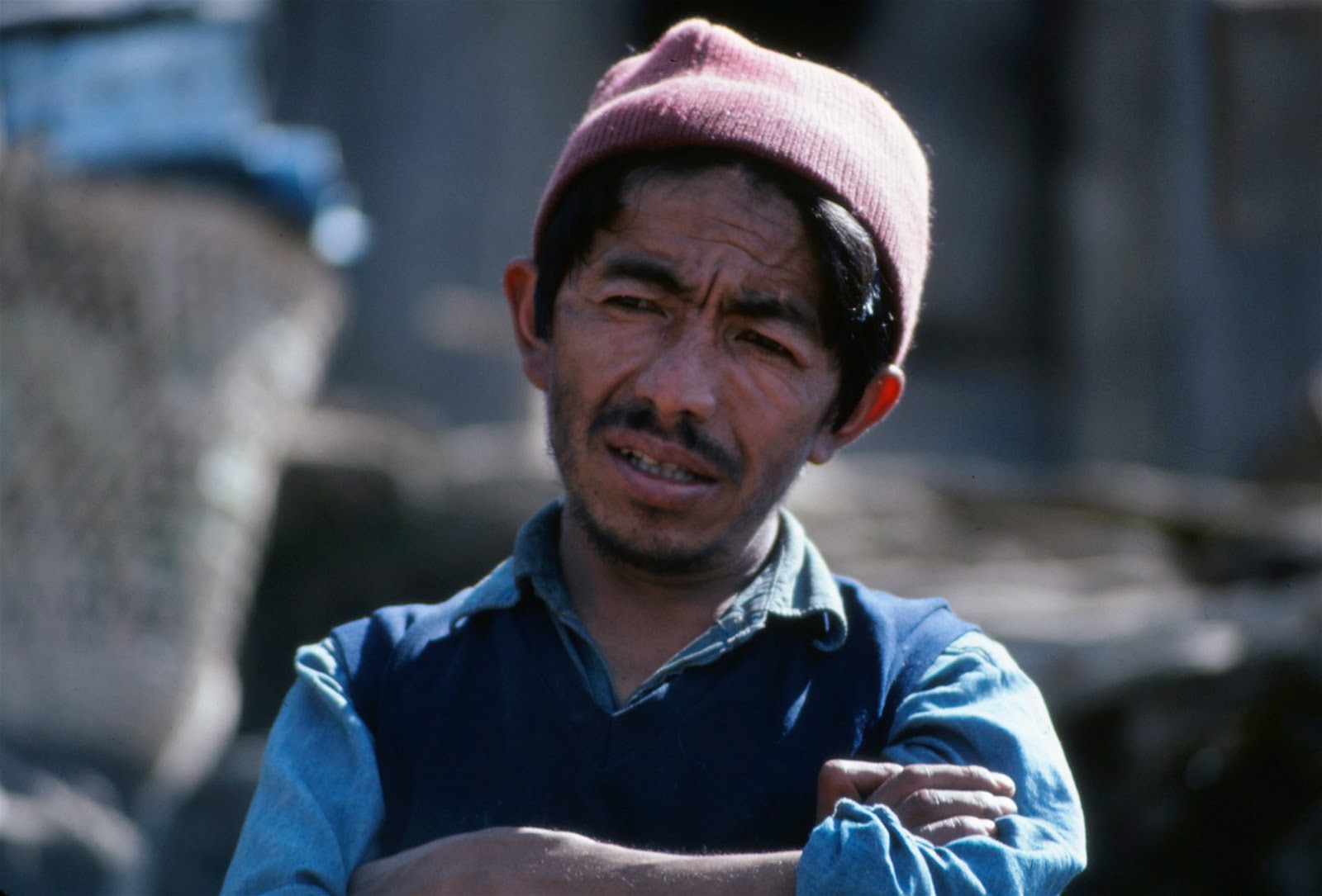
Pema Dorje, a cook's assistant.
After lunch, the trail did not meet our expectations.  I found myself angry a few times.  It's important, I guess, to take it all as it comes instead of looking forward.  For the past few days, I've been thinking about Namche, the cold we should encounter, etc., instead of enjoying what we have.

Anyway, the trail description read "the trail climbs steadily but gently for 1000 feet."  To me, it was steep, rugged and long.  After one hour we reached the top of the ridge where a small tea shop stands.  I bought a few packages of biscuits for Rs 5 (an inflated price), then polished off one package immediately.  As we descended, the trail was covered in snow and slush, the sky was foggy and cloudy, and the hiking was very slippery.  For a half hour I remained frustrated and upset, but I finally relaxed and began enjoying the trail.

I thought a lot about my work and my life and where it is going.  I guess Ingrid and I will try to have children shortly after we return and I think I am ready for that experience.  I'm beginning to view my career at LBL as finite, although there are still some important things to accomplish -- perhaps 18-24 months more will do it.  Then?  Maybe finish my PhD, if the kid thing doesn't work out.  The other alternative options are to work in the energy industry or in the infant robotocs industry.  I must begin doing some research when we return.

Our camp is reached at 3 PM.  It is in a sort of pastureland in a little (7 house) village called Puiyan.  The fog lifted once for 15 minutes and gave an excellent view of the ridge we just crossed -- snow covered and steep.  Now at 5 PM, it's low clouds and about 40 °F, although it seems colder.


9 February 1981
We made it to Namche and it is FA cold!  The low last night was 6 °F; this morning it is beautifully clear and in the low 20s.
View north along the Dudh Kosi
Two days ago, we continued northward up the Dudh Kosi valley from Puiyan.  The morning was uneventful.  After climbing gradually about one hour, we crested and could see the Lukla airstrip through the trees.  I missed an excellent photo opportunity with a pink-dawn peak.

From the ridge crest, we descended steeply on the north side, across an icy trail.  I bottomed out once.  George went head over heels. (!)  And yet some of the porters were almost jogging down.
Two young girls in Surkhe
We crossed a tributary of the Dudh Kosi at Surkhe.  In this village, we stopped at a tea shop and had roasted soybeans.  There was a woman in bed in the room -- she had just had a baby a week before.

Our lunch stop was by another stream about 500 feet above the village.  The cooks were on one side, the trekkers on the other.
Children on the trail along the Dudh Kosi
Broad stone trail near Chauri Karka.
After lunch, things got a bit more exciting.  We walked through an interesting and large village called Chauri Karka.  The trail was broad and newly stone paved.  Beyond Chauri Karka and for the rest of the long afternoon, we passed people returning from the Namche market, which happens every Saturday.  We passed several hundred people traveling opposite to our direction, most carrying partly empty baskets and walking sticks.
Elderly couple on the way to Namche Bazar.
Along one stretch of the trail, near the end of the day's hike, the road crew was out.  Dozens of people were working with hoes, spades, sledge hammers and crow bars to clear rocks and level out the soil.  They were even blasting -- drilling (?) holes in large rocks, filling them with blasting powder, and running a hefty foot-long fuse from them.  As we were passing such a section, the whistling began and the porters and other travelers started running past us.  After a few minutes, the blasts began -- about five within one minute, with very loud and long echoes.

We finally made it to camp at 4:30.  We had a camp fire before dinner.

Woody had gone to Lukla with Nancy Jo and Sardar Sahib to replenish our supplies.  The supplies were carted back by dzos (half yak/half cow).  He brought us each chocolate bars -- a wonderful treat.
Bridge across the Dudh Kosi at Phakding.

This camp was our last at low altitude (below 10,000 feet).  The village name: Phakding.
Mani rock north of Phakding
Sunday began with a pleasant walk along the Dudh Kosi.  We crossed a few bridges, passed some small towns, and went by a wonderful mani rock, with its 10-20 foot face covered in 6" letters, carefully carved.

We stopped in Jorsale at a tea shop for rakshi, chang, tea, popcorn, and soybeans.  The place was extremely neat and pleasant.  Woody had met one of the woman's daughters in Kathmandu.  The woman's husband was one of three people in Jorsale who had died when an avalanche fell into a lake causing a tidal wave through the Dudh Kosi valley.

Just beyond this stop, we came upon the Hatago Restaurant and Hotel, a sharp Japanese run place, unfortunately closed for winter.

A man with a young child stopped us on the trail asking for medicine.  The child had a severely infected ear.  Woody suspects scabies and told him to go to a doctor in Namche as soon as possible.

Our lunch stop was on the banks of the Dudh Kosi.  The water was 34 °F.  Nancy Jo, while wringing some socks she was washing, fell in to her waist.  Brrrh!

After lunch, we began a 2000 foot climb to Namche.  I hiked very slowly, not allowing my breath rate to quicken at all.  Still, I made it in 2.5 hours.  Near the top, we saw an impayan pheasant, Nepal's brilliantly colored national bird, and a lammergeier, a huge vulture with a wingspan of up to 9 feet.
Trek leaders: Woody Underwood and Lhakpa Tenzing
Namche is set in a west facing horseshoe bowl.  There are about 100 buildings and shops with all sorts of goods.  Ingrid and I bought chocolate bars and put them away.  I bought a wool hat and scarf for Rs 95 (about $8).

After some shopping and signing in at the police checkpost, we walked to Lhakpa Tenzing's home, where he served us rakshi, chang, and boiled potatoes.

The weather was pretty poor, with corn snow falling most of the late afternoon and early evening.

Glenn was rather plastered on rum and rakshi.  Yuck!

We ate in a Himalayan Journey's office (?) sparsely appointed with wood benches and tables and no heat.

We've bumped into a few other trekkers up here, but not too many.
On the (empty) streets of Namche Bazar, before departure.
This morning, we are off to a late start, since Tengboche is only a few hours' walk.  Most of our group is stocking up on chocolate and other supplies.

The day is beautifully clear and it should be very warm in another hour or so.
Spinning a prayer wheel on the trail to Namche Bazar

Wednesday, July 31, 2019

Nepal (1981) Part 5


One of our porters, carrying three tents with a tumpline.
4 February 1981
Nuntale

Yesterday was dominated by my illness.  I got a pretty serious case of diarrhea, probably from the shitty lunch stop by the river the day before, or perhaps from eating salami there -- it seemed to be a bit off.  I took lomotil in the morning and it seemed to be fairly effective.  Unfortunately, I misplaced the stuff and couldn't take the noon dose.  At 3 PM, I dumped all that remained, with great pain.

The day for me was exhausting.  Uphill walking made my head throb -- especially after lunch -- and Ingrid had to carry everything for a few hours in the afternoon.  I only drank black tea until supper.

We began by climbing along the ridge line steeply above Sagar.  There were a few houses along the way.  These people don't seem to farm, but rather live off animals.  We saw some magpies with beautifully long tails.  After three hours walk, we reached our lunch stop at about 11,000 feet elevation.  The stop was near a shepherd's house.  A Tibetan monk came by and offered us a copper necklace for an outrageous Rs 1000 (Rs 100 seemed a fair price).
Prayer flags at Lamjura Pass
After lunch, we climbed another 600 feet, then did a long traverse across a snowfield with rhododendrons everywhere.  After 1.5 hours traverse, we descended (!) to Lamjura pass at 11,580 feet.  From there we descended steeply, under cloudy skies, for an hour.  As the terrain flattened, we walked out from under the clouds (they seemed to gather around peaks and along ridges in the afternoons).  We did a long traverse to Junbesi, a large, interesting village.  We sat inside a tea shop with Woody and Nancy Jo, then went on to camp, which was in a shady spot right alongside the river.
Our first great view of the mountains; Everest at left.
As we came into Junbesi, we had excellent views of Numbur and some other peaks.

I spent the evening in the tent and ate only rice and soup for dinner.

This morning, I was feeling much better.  Our morning hike climbed through pine forest east of Junbesi in the fog.  We did a long traverse around the ridge separating Junbesi from Ringmo.  As we rounded the southeast end, we got our first view of Everest.  It is mostly black, far enough away to seem unimposing, and had a white plume near its top from blowing snow.  We could also see Nuptse, a long, flat peak, and the southern face of Ama Dablam.

We continued our traverse northward, passing through Salung, where we stopped at the "Everest View Hotel." (!) Here, Woody and Nancy Jo were drinking chang, a fermented milky colored drink made, in this case, from corn mash.

Our lunch stop was by a river and Ingrid and I washed our hair in the icy water.
All the trekkers at our lunch stop near Ringmo.
After lunch, we climbed through Ringmo, a beautiful village on a hillside with the appearance of a southern plantation.  There are apple orchards here and we bought some apple rakshi (a distilled liquor).
Foggy conditions at the (closed) Trakshindo Cheese Factory.
Fog shrouded stupa at Trakshindo Pass.
We continued climbing toward the Trakshindo Pass, stopping along the way at a cheese factory that, unfortunately, was closed.  We were treated, however, to the sight of two yellow-throated martens -- large, omnivorous mammals with black fur and yellow throats and about the size of anteaters.
Bill and Lhakpa Nurbu in the forest below Trakshindo Monastery
At the pass, the clouds and fog were thick.  The temperature was only 36 °F, very low for early afternoon.  We descended via the Trakshindo Monastery, where we stopped to see the gompa.  From there, the trail passed through a lovely wet forest land -- with the heavy fog, it appeared almost enchanted.  The trail descended fairly steeply to Nuntale, our camping spot.  This village is the most medieval that I've seen in Nepal.  About 15 buildings line the trail.  In one, a woman was grinding corn using a hand spun millstone.  There is a rack of drying corn in the middle of the village and a chicken sits atop it eating kernels.  (The rack is 10 feet high.  How did the chicken get up there?)  Two young men chase a pig and catch it by a rear leg and pull it screaming into its pen for the night.


Nepal (1981) Part 4

Sister carries younger brother outside tea shop
2 February 1981
Sagar Schoolyard

Today is Monday and we've now been on the trail for 8 days.  Both Ingrid and I are in fairly good condition, health and spirits.  We have no trouble now completing the day's hike and still feel fine in the evening.  I am still bothered slightly by a nagging sore throat and Ingrid's knees give her some trouble.  And I still have some small fears about the altitude and the cold as we progress.

Saturday afternoon we made a long traverse and gradual descent to Mali.  The walk was on a dirt trail along an undulating ridge top that reminded me of the hills near El Sobrante in the summer.
Nepali children at Mali
Burning fields near Mali.
As we descended, we passed one village where they were fertilizing the fields.  They gathered all of the left over weeds and dried crop stumps and dung into piles and set them afire.  The piles mostly smoldered -- with many burning the whole field was smoky and with the people busy gathering more piles and the sun low in the sky the whole operation reminded me of some autumnal rite.
Nancy Jo, Ingrid, and Woody on the way to Mali.
In Mali, we stayed on a broad flat field.  The late afternoon was windy and cold -- after sunset the wind died down and it became more pleasant.  Our dinner this night was the last with Kerin as cook and it was a lousy one: mashed potatoes, overboiled noodles, cauliflower and a cheesy sauce.  The next day, Kerin was replaced by Lhakpa Tenzing's usual cook, Ung Tharkey, who had been unable to meet us early on because the Lukla airport was snowed in.
Porters crossing the bridge to Kenja.
Sunday was a relatively easy hiking day.  We descended to the river from Mali, crossed a bridge at 5800 feet and bought biscuits from a small shop.  Here, we rejoined the main trail.  We climbed a few thousand feet before lunch.  At first, the way was steep, but it soon turned to a gradually climbing traverse.
Glenn visits with Nepali children at lunch stop.
Our lunch stop was at a tea shop that was most interesting.  The house was made of wood instead of the stone and mud we usually find.  In the yard was a picnic table and benches -- most pleasant!  There were several small kids about.  They had a 4-month old water buffalo and a nanny goat that had just that morning given birth to two kids.

In the afternoon, about half the group went to Thodung, a cheese factory at 10,150 feet elevation.  We instead headed directly for our stop at Bhandar (Changma).  First we ascended to an 8900 foot pass.  At the top was a tremendous set of mani walls and good views back to Timsang Lo and forward to Lumjore La.  There was a small hotel there, Hotel Mane, and inside were 6 or 8 people, apparently just back from a wedding, drunk on Rakshi and singing out of tune.
Stupas at Bhandar
Our descent was slow and pleasant to Bhandar.  We stopped at a monastery/gompa with two handsome stupas.  We also stopped at a woodcarver's shop.  Lhakpa Tenzing bought an attractive rakshi bottle for 40 rupees here.  At camp, we visited the porters' night spot.  Ten or so were upstairs in a dark building preparing their dinners.  For most, the fare was spicy greens boiled and a pasty dough made by mixing flour in boiling water.
In a kitchen in Shiulaya
Our dinner included fried chicken, tough as I imagine jackrabbit to be.

Today was a similar hiking day to yesterday.  We descended the bridge below Bhandar to the river, followed it to its confluence, crossed, then traversed upstream for about 90 minutes to a small town.  We washed clothes and lunched by the stream.  In town, Ingrid and I bought 500 g of hard candies (20 rupees) and saw three women grinding some yellowish grain (corn?).  While two women lifted and dropped the mortar with their feet, the third scooped up the flour into a woven basket and sifted it in a similar manner to gold panning.

After lunch, we ascended very steeply (but also rapidly, as we are getting much stronger) about 2700 feet.  We did the lion's share of the climb in about 1.5 hours.
Bill on the trail, Sagar in the background.
Our campsite is in the schoolyard of a village called Sagar.  This is the site of one of the schools that Sir Edmund Hillary built.  Also in town are a stupa and gompa with two big prayer wheels and some nice paintings.

When the clouds lift, there are excellent views of some of the peaks NNE of here.  I took some photos of them at sunset.  There was also a brush fire burning out of control on the hillside, covering a few acres, perhaps.

Before and during dinner, we played Scrabble.  We ate in one room of the school house (not Hillary's building -- it was locked).  The temperature at 8 PM was about 32 °F and, as is typically the case, there was neither wind nor clouds once the sun set.  The moon is very nearly new.

Monday, July 29, 2019

Nepal (1981) Part 3

Young child near Khartali
30 January 1981
From Amatal, we continued our eastward traverse high above the river.  For the first hour, much of the land was cultivated and inhabited.  We came upon a beautiful house -- actually three buildings in a yard with fruit trees -- extremely fancy by Nepal standards.  A young man invited us into the yard and we had a look around, then shot some pictures.  (We are to send him one of himself and his mother.)  His address indicates that his father is the village mayor, which may go a long way to explain the nice home.
Nice home at village Panchayat.
Another hour took us to the top of the spur of this ridge.  The countryside here was very arid and sparsely populated.  We hiked down about 1000 feet to the confluence of two rivers, where lunch was being fixed.  The river provided a good opportunity for bathing, but it was too cold for me and Ingrid had forgotten her bathing suit, so we just washed hands, faces and legs.  After lunch, Ingrid began suffering from an upset stomach (bloated) and I also felt lousy, primarily from a sore throat.  The afternoon hike was very long, although flat, following the river.  In many places, small sections of the trail were washed out and the footing there became uncertain.
Trailside house near Amatal
We finally reached camp at an elevation of 3300 feet on the bank of a river in a fallow rice field.  Ingrid conked out almost immediately and I passed out at 8 PM, shortly after dinner.  (I only ate soup and dessert.)  I was feverish and had a bloated stomach for a few hours -- I think a result of exhaustion.  I was almost hallucinatory in my sleep with very unsettled dreams.  Finally, before midnight, the fever broke and I slept well the rest of the night.

The bugs were terrible at low elevation, even during this winter period.  My lower lip was bit and had swollen to twice its size.  I still feel, after four days, that I am not getting any stronger.  I am more sore and tired with each passing day.

Today, it seemed that nobody wanted to get out of bed and the kitchen crew had to whistle us to breakfast.  I just had black tea -- my stomach not yet being right.  We hiked a nice flat trail for about an hour, coming to a chain bridge.
Children in the village of Bigute
We took a short side trip to a bazaar town that had perhaps six shops selling slate for roofs, batteries, cloth, and some other general sundry goods.  We then crossed the river and began a steep ascent towards our second pass.
Crossing the Tamba Kosi.
Another bridge, across a smaller river.
We saw at the bridge a wedding procession with the young bride carried by her father in line with several musicians.
Nepali woman at Juka.
We climbed about 1500-2000 feet before stopping for lunch in the village Juka.  After lunch, we hiked another three hours, traversing and slowly climbing towards the south.  I'm feeling stronger today than yesterday, a good sign.  We stop well short of our scheduled goal; however, this is no great surprise as we are the first Himalayan Journeys trekking group to walk the Bharabise-Mali stretch.

We have a good storm for an hour or so near sunset, with thunder, lightning, rain and hail.

Good views of Gauri Shankar as we climbed today.
Yak driver, Pema Dorje, Sila, Jeta, Dhan Bahadur, Ang Lhakpa, Dorje
Among the Nepalese working on our trek are these men:
• Lhakpa Tenzing Sherpa (the Sirdar) -- he is in his late 30s, has climbed Everest (1973 Italian expedition) and Daulagiri
• Jetha Sherpa (guide) -- about 18 years of age
• Lhakpa Nurbu Sherpa (guide) -- also about 18, from Namche Bazaar
• Kerin (cook)
• Dorje (cook's assistant)
• Duan Bahadur (cook's assistant)
Our trekking group was small, eight in all including the leader:
• Tom -- from Palos Verdes, CA
• Glenn -- from Cambridge, MA
• Hugh and Terry with their son, George (age 12) -- from New York, NY
• Nancy Jo -- from Madison, WI
• Ingrid and Bill -- from Oakland, CA
• Woody -- the western trek leader, with Himalayan Journeys in Kathmandu
31 January 1981
Lunch Stop
We woke early today -- tea at 5:45 AM -- and were on the trail by 7 AM.  We continued our southeastward traverse climbing toward the head of the valley through forested land.  There was a small amount of fresh snow on the ground from last night's storm.

We reached Serukapti after hiking about an hour, then began a steep climb of about 2000 feet to the pass.  The climb was deceiving.  We climbed very steeply up a slope for about an hour -- very tiring.  As we continued, the trail followed the spur of the ridge for another 45 minutes.  We finally seemed to crest, but instead had to climb the ridge -- fortunately for only 15 minutes.  From the crest, at 9400 feet, we again had a view of Gauri Shankar and several other peaks.  We hiked a slowly descending traverse for another hour before reaching our lunch stop on a hot southern slope.  The air temperature was about 72 °F, but with very bright sun.  The hillside is uninhabited and we have a good view down to the village Jiri in the valley below.  The vegetation is largely fir and pine trees plus rhododendrons.

Both Ingrid and I feel well today and fairly strong.  We may be over the hump as far as our condition is concerned.  We slept very well last night for the first time on the trek.  I'm beginning to get into this thing!


Saturday, July 27, 2019

Nepal (1981) Part 2


28 January 1981
When we reached Barabhise, our starting point, the porters and Sherpas were assembled and (for some unknown reason) camp was set up. 
Camp is set up for our lunch stop at the start in Bharabhise.
We ate lunch of lemon tea, cheese, salad (!), bread and omelets.  After lunch, we officially began trekking.  Barabhise, at 2700 feet, is a large Nepalese town with perhaps 1000 population.  We crossed the river, headed up the main street, turned right (east), and began climbing some steps.  After climbing perhaps 500 feet, we reached an official rest spot: a large peepul tree with stone platform, a resting bench for porters to set down their loads, and some prayer stones.  The countryside was largely uninhabited with rice paddies covering most of the land.  The people in the lowlands are typically Chettis of Hindu faith.  Their features are more Aryan than the Bhotis (including Sherpas) who descended from Mongoloids.
Children outside home near Khartali
Trekkers pause for a rest on the afternoon of the first day.
We climbed perhaps 1000 feet more before reaching a beautiful lookout point from which a huge amphitheater could be seen to the east and the river valley could be seen below. We began a traverse along the mountainside with some gentle elevation gain and after hiking about 1.5 hours more we arrived at our camp in an idle rice paddy near the village of Khartali (elevation 5500 feet).
Curiosity about trekkers camping in Khartali
We ate a dinner of rice and pork stew by lantern and turned in fairly soon after.
Cook's assistants on the trail: Dorje and Dhan Bahadur.
The weather was generally clear with a high of about 75 °F and a low of 40 °F.
Mother and son.
We awoke Tuesday at 6:15 and, after packing our gear, had breakfast of thin porridge.  We climbed several hundred feet before reaching a beautiful point with terraced fields of wheat and a good view of our ridge to the east.
One of our porters.
Plowing the fields in Porteng.
We continued to hike in and out of side valleys, crossing streams and slowing gaining elevation.  Our pace was pleasant, with several stops along the way.  We climbed steeply to a ridge crest and to a village called Porteng, which consisted, as far as I could see, of a tea shop only.  We ate lunch in Porteng (elevation 7500 feet).  We were treated to an excellent view of the pass -- Tingsang La -- that we would eventually cross.
Terraced fields 1 h past Khartali
I felt excellent on Tuesday.  The hiking was hard but the pace was comfortable.  All of us had ravenous appetites, particularly at lunch.  We were supposed to reach Tingsang La on this day, but the distance was too great -- we required 1.5 hours to reach the bottom of a 3000-4000 foot climb.  So, instead, we hiked until 4 PM, reaching Kapka (summer pasture) at 9000', and here we camped.
Husking corn near Dolangsa
The area was isolated.  About 1000' below, we passed a Sherpa village, Dolangsa, and we visited the gompa (Buddhist religious center) there.  This one contained statues of three main incarnations of Buddha (prophets?) including Avalokeshivar (?) a Tibetan.  There were also religious prayer books wrapped in cloth and pictures of some Hindu deities.  The room was about 10 x 15 feet and we paid a few rupees for the privilege of seeing the inside.
Water powered corn mill at Dolangsa
In the evening, the spirit of the trek, so high before, was dampened by a theft.  Tom and Glenn had their daypacks ripped off from the head of their tent, presumably while we were eating dinner.  Woody and the Sherpas searched that evening and the next morning; what evidence they found suggested that the thieves were long gone.  The tea shop owner at Porteng reported hearing 3 people trotting down the trail at 9 PM Tuesday night.  Tom lost $85 and a parka but took it well.  Glenn lost two cameras and was very upset.

It got super cold that evening, dropping to 16 °F.  The next morning was most miserable, since the sun didn't rise until long after dawn and, due to the search, we didn't begin hiking (and warming up from the exertion) until 9 AM.

Wednesday's hike began with a steep climb up 2000 feet to Tingsang La (elevation 10,900 feet).  We passed through rhododendron forests and snow covered ground.  The final 20 feet to the pass was tough going with negotiating a narrow channel of steep rock steps, covered with ice and snow.  From the top, we had an excellent view of snow-capped peaks, including Gauri Shankar at 23,400 feet and Melungtse at 23, 500 feet, which I photographed.  There was much snow on the downhill side of the pass; however, the slope was gentle.  The porters could often be heard laughing a storm as one or another of them slipped and fell.  Both Ingrid and I took spills in mud as we hustled for a good hour to reach our lunch spot.

I was feeling rather lightheaded, a combination of the altitude, the exertion, and the bright, bright sun.
Among our first glimpses of snow capped peaks.
After lunch, we descended steeply, through forests of oak (stripped of its branches for firewood), rhododendron, maple, and magnolia.

We crossed a small stream after descending about 2000 feet and then the trail leveled off as we passed through a very moist region (it was cool at this time of year though).  There were ferns and moss and very green growth throughout.

We saw some lampur monkeys with black faces and gray hair at the edge of the forest.  The trail then opened up to a beautiful traverse on the south side of a small river.  The range visible from Tingsang La could be seen as well as terraced fields extending large distances up from the river on both sides.

After a very long afternoon hike, we reached our camp site at Amatol.  Dinner was late because the cooks had taken a longer route and only caught up to us just before we reached Amatol.
Boy playing at a rest area along the trail near Amatol.
I felt sort of lousy most of the late afternoon and evening -- I think the third consecutive hard day of hiking wore me out.  My legs and shoulders ached and I was slightly chilled from a mild sunburn.


Nepal (1981) Part 1


Cleaning out old stored items, I came across a journal that I wrote during our trek in Nepal from the winter of 1981.  I've decided to reproduce it on the blog. 

The trek duration was about 3.5 weeks.  I've posted it in nine entries.  The images are a combination of new scans of 35-mm slides taken during the trip and new photos of stored memorabilia.
26 January 1981
Well, the long awaited time has arrived.  Today we are off on our 24-day trek from Barahbise to Kala Pattar.

We arrived in Kathmandu on the day before yesterday after a week in Bombay.  In Bombay, I spent the week attending a conference: Second Special Symposium on the Natural Radiation Environment at the Bhabha Atomic Research Center (BARC).  Ingrid visited Bombay and spent much time with relatives of Pram Garg, an ex-clerk at Pacific Telephone.  The relatives were Mridula and Vishnu Paddar, Urmila Roongta and her husband, and Neeta, Pram's cousin.
Sunset in Bombay
For me, the stay was quite tiring.  We typically were up at 6 AM and had tea and toast (room service) for breakfast.  At 7:30, the bus came for the one-hour ride to BARC.  We met for most of the day, with 1.5 hours for lunch.  At 5 PM or so, the bus would return us to our hotel or, more commonly, take us out for the evening program.  Monday night, we were treated to a banquet at the Taj International (*****), Tuesday in the gardens of the Hotel Horizon at Juhu Beach, Wednesday there was a lovely program of Indian classical dance.  Wednesday evening, Ingrid and I ate dinner at Mridula's -- Indian style chupattis with dal and other curries and no utensils at all.  On Thursday, we ate at Urmila's. Both families are upper middle class with cars and multibedroom flats.  Urmila's husband works for the trains; Mridula's is a sales rep for Newsweek and other publications.  These people were wonderful to us, really helping us to understand some of the good things of Indian life: close family, and moderately easy life (Mridula has 2 servants).
Dinner at Urmila's included "dress up" for Ingrid and me.
Bombay is in a scenic setting but it is extremely congested.  From our hotel to BARC is about a 15 mile distance and the drive took 45-90 minutes, depending on traffic.  Many people in the city have come from rural areas looking for work, but prices are so expensive (by Indian standards) that they must live in shanty town shacks built of stone or thatch or wood and rags; these have sprung up all over the city.

Our hotel, called Nataraj (god of dance), was decent although hardly up to its 4-star rating.

Other than a moderate stomach ache for 8 hours or so on Monday night, my health was okay.  I probably lost a few pounds though as my stomach seemed tender and my appetite modest.

Our flight over (to India) was smooth, although tiring.  We landed Monday 3 AM after ~ 24 hours.  It took 2 hours to clear customs & immigration.  We were met by someone from BARC and carted to our hotel.  I then had about 2 hours before the conference began.  I didn't catch up on sleep all week.

The conference was fairly good.  Indoor radon is not as hot an international topic as I had expected, although quite a few papers dealt with the topic.  I presented two papers, one on alpha spectroscopic techniques for radon daughter measurement, the other a general overview of our program.  The papers were well-received, although the audience numbered only about 60.

Our trip to Nepal was typically unpleasant.  We checked out of our hotel at 5 AM Saturday, took a taxi to the airport and caught a 6 AM flight to Delhi, arriving 7:45 AM.  Our connection to Kathmandu was scheduled for 9:30 AM, but, somehow, it departed at 8:15 AM, before we reached the check-in counter.  We then had to sit around the Delhi airport for what turned out to be 7.5 hours before catching an RNAC flight.

We were pleasantly surprised on arrival to be greeted by Woody, our trek leader.  Backtracking, our flight into Nepal was less scenic than normal because of heavy clouds and rain.  As we dropped into the valley, however, we got a tremendous view seeing widely spaced, multistory houses, gentle roads and streams, the terraced rice fields and the brick factories.  The appearance was very quaint and my face exploded in a smile.

We stayed at the Yellow Pagoda Saturday and Sunday before departing today on our trek.  The accommodations and service were excellent.

27 January 1981
On Saturday, we arrived about 5 PM and after a brief meeting about the trek, I conked out.  Sunday, we were taken on a short tour of the city, visiting Pashupatinath, a large Hindu temple, and Bodinath, a large Buddhist stupa and monastery.  After lunch, we bought two Tibetan carpets, one for my parents and one for us.  They are top quality, 3' x 6', and cost Rs 1125 (US$95), down from Rs 1300.  In the evening, we had a lengthy pre-departure meeting and packed our gear carefully for the last time before departure.

The hotel food was excellent and very great in quantity.  Breakfast was fruit juice, cereal, eggs, toast & croissants, and tea.  Lunch and dinner consisted of soup, meat, vegetables, potatoes & dessert.  The weather on Kathmandu was not excellent.  It rained Saturday and was overcast Sunday; on Monday when we departed, it was socked-in foggy.

The long awaited (!) moment had finally arrived.  I was literally quivering with excitement.  Physically, I don't think I have ever felt better in Asia and I'm certain that much of this well-being is attributable to my mental state.

The bus ride was about 3 hours, although we traveled less than 90 km.  During the ride, Ingrid and I sat in the front of the bus. As we headed NE from Kathmandu, we began climbing and finally lifted out of the fog.  As we reached the top of a ridge, we got our first views of the mountains.  Spectacular!  Spanning almost 180 degrees on the horizon -- heavily snow capped and very craggy.  The countryside was well populated alongside the road and we passed many small villages and road toll booths.  We crossed the Sun Kosi, a large river basin, passed a hydroelectric plant (Chinese built) on the Bhote Kosi and finally a Swiss built steel-girder bridge that marks the beginning of the traditional route. 

Reminiscing

A long overdue post-retirement activity is cleaning out all of the old storage throughout our house (attic, basement, garage) and my office.  I made negligible progress during the first year, but with Ingrid's encouragement and my own growing sense of unease, I'm determined to do better starting now.  We're beginning with the garage.  I completely tossed (recycled) a full box of paper that was the final typescript of a textbook I co-wrote.  That effort started in earnest during sabbatical in Israel (1996-1997) and was finished a few years later (copyright date: 2001).  The book was a reasonable success, selling more than 10,000 copies.  It is still in print and still being used at Cal in the class for which it was written.  Buried in this box of papers was a cover art concept that I drew; it's displayed here along with the published version of the cover.